
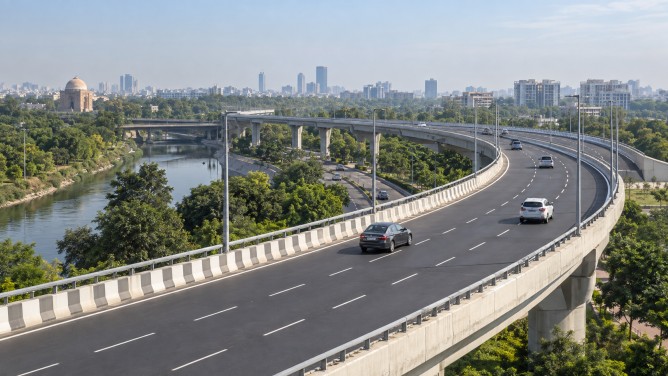
The opening of Delhi’s long-awaited Barapullah Phase III elevated corridor is set to transform daily commutes by drastically cutting travel time between East Delhi, Noida, and South Delhi. Scheduled to open to the public on September 29, the corridor promises a time-saving, mostly signal-free journey, potentially reducing travel time from 35–40 minutes to just 15 minutes.
This 3.5-kilometer elevated corridor will link Mayur Vihar Phase I with Sarai Kale Khan, seamlessly integrating with the existing Barapullah corridor. The new infrastructure includes a bridge over the Yamuna River, nine traffic-distribution loops, connecting ramps, a dedicated cycle track, and pedestrian facilities, all designed to enhance connectivity and ease congestion in one of the busiest parts of Delhi.
Approved in 2014, the project faced numerous delays due to challenges such as land acquisition, construction hurdles, and the COVID-19 pandemic. Initially estimated to cost ₹1,260 crore, the project’s budget has risen to approximately ₹1,635 crore. Despite these obstacles, major components, including the Yamuna bridge and connecting ramps, have been completed, paving the way for the corridor’s imminent debut.
Officials are optimistic that the new corridor will alleviate traffic woes for daily commuters, particularly those traveling between East Delhi, Noida, and key areas like AIIMS in South Delhi. The reduced travel time and improved connectivity are expected to provide significant relief to thousands of commuters navigating the city’s bustling roadways each day.