
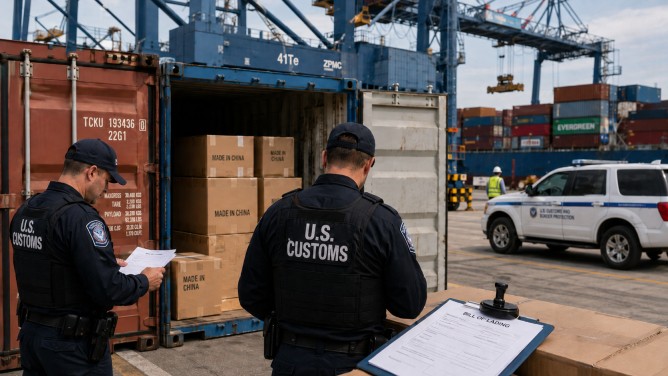
The United States has leveled accusations against 38 countries and the European Union, alleging their involvement in a “shadow transshipment network” that purportedly enables Chinese goods, subjected to steep U.S. tariffs, to penetrate the American market via third-party countries. This claim is detailed in a report titled “The Great Transshipment Scam,” which estimates that this potentially illicit activity could be valued at approximately $60 billion, leading to considerable losses in U.S. tariff revenue.
The report names a diverse array of countries and territories as part of this network, including India, Canada, the European Union, Israel, Japan, Mexico, South Korea, Taiwan, Brazil, Indonesia, Malaysia, Thailand, Turkey, Vietnam, Argentina, Azerbaijan, Bangladesh, Cambodia, Chile, Colombia, Costa Rica, the Dominican Republic, Georgia, Jordan, Kazakhstan, Kenya, Laos, Morocco, Myanmar, Oman, Panama, Peru, the Philippines, Singapore, Sri Lanka, Switzerland, the UAE, and Uzbekistan. It further notes that goods worth about $67 billion destined for the U.S. were allegedly rerouted from China through major transshipment hubs such as Mexico, India, and Vietnam in 2025, potentially resulting in an estimated $28 billion loss in U.S. tariff revenue.
Highlighting specific cases, the report points to the Pune-Gujarat-Chennai corridor in India, where Chinese shipments of items like electric pumps and compressors are said to have bolstered local businesses while simultaneously heightening competitive pressures on U.S. manufacturers. This example underscores the broader economic impact of these transshipment practices on American industries.
In response to these findings, the United States is contemplating a series of measures aimed at curbing these transshipment activities. Proposed actions include implementing more stringent inspections and interdiction processes, imposing additional tariffs, applying sanctions, and possibly limiting market access for countries that facilitate tariff evasion. These strategies are part of a broader effort to safeguard U.S. economic interests and enhance the enforcement of trade regulations.
This development underscores the ongoing challenges faced by the U.S. in its trade relations and highlights the complexities of global supply chains. By addressing the issue of transshipment, the U.S. aims to reinforce its tariff policies and ensure a level playing field for domestic manufacturers.