
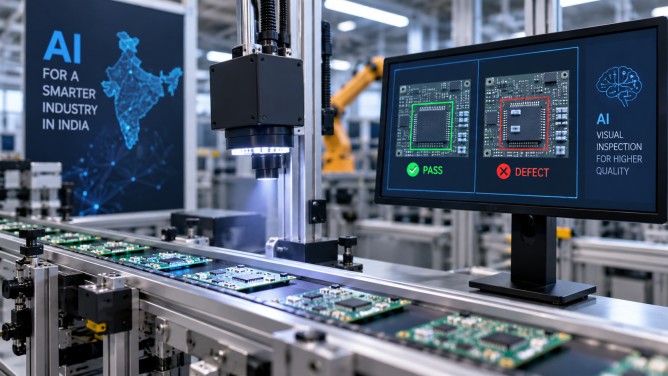
Swedish company Opsio has introduced PrismIQ, an automated visual inspection service aimed at revolutionizing defect detection in manufacturing. This cutting-edge service is first being launched in India, with plans for a broader global rollout. PrismIQ utilizes industrial cameras paired with deep-learning models, trained to spot issues such as surface defects, cracks, contamination, dimensional variations, and assembly errors during the production process.
The technology is built to operate on edge hardware located directly on production lines, ensuring quick processing of inspection results without relying solely on manual checks. It can also integrate with existing PLC and SCADA systems to facilitate automated sorting and decision-making on the production line. PrismIQ addresses challenges faced by manual inspection, particularly in high-speed manufacturing environments where examining every product is impractical. Additionally, the system employs active-learning techniques to continuously improve its detection models based on production data.
Unlike typical standalone vision software, PrismIQ is offered as a comprehensive, end-to-end service. Opsio takes responsibility for configuring the cameras, lenses, and lighting, developing and validating the models, integrating factory systems, and managing ongoing operations. The service package also includes operator training, quality dashboards, and periodic performance evaluations. According to Opsio, a standard implementation can transition from feasibility assessment to full production deployment within eight to 12 weeks.
India’s rapidly growing manufacturing sector, coupled with Opsio’s existing foothold in the country, made it a strategic choice for the initial launch. Opsio runs an AI Lab in Bengaluru where industrial artificial intelligence solutions are developed and tested. The technology itself is engineered from Opsio’s headquarters in Karlstad, Sweden. Initially, PrismIQ is available to manufacturers in sectors such as automotive, electronics, food and beverage, and pharmaceuticals. The engagement process starts with a feasibility study and proof-of-concept using samples from the manufacturers’ own products.
Opsio’s Chairman, Daniel Hedlund, highlighted India’s manufacturing growth, stating that quality will be key to achieving lasting global competitiveness. Praveena Shenoy, Country Manager for Opsio India, expressed optimism that automated inspection will enable manufacturers to detect defects earlier and enhance their quality-control processes.
Legal Disclaimer:
The information contained in this article has been provided by independent third-party contributors, clients, or content partners. We do not independently verify the accuracy, completeness, legality, ownership, licensing, or reliability of submitted content, including text, images, videos, trademarks, or other media materials. The submitting party is solely responsible for ensuring that all content, including images and media assets, complies with applicable copyright, trademark, licensing, and intellectual property laws. We disclaim liability for any unauthorized use of copyrighted or proprietary materials by third parties. If you believe that any content published on this platform infringes your intellectual property rights, kindly contact the author above for prompt review and resolution.